
All the mobile providers have confirmed with the UK Government that they do not plan to offer their 2G and 3G services beyond 2033.
2G Switch Off: Why is this happening?
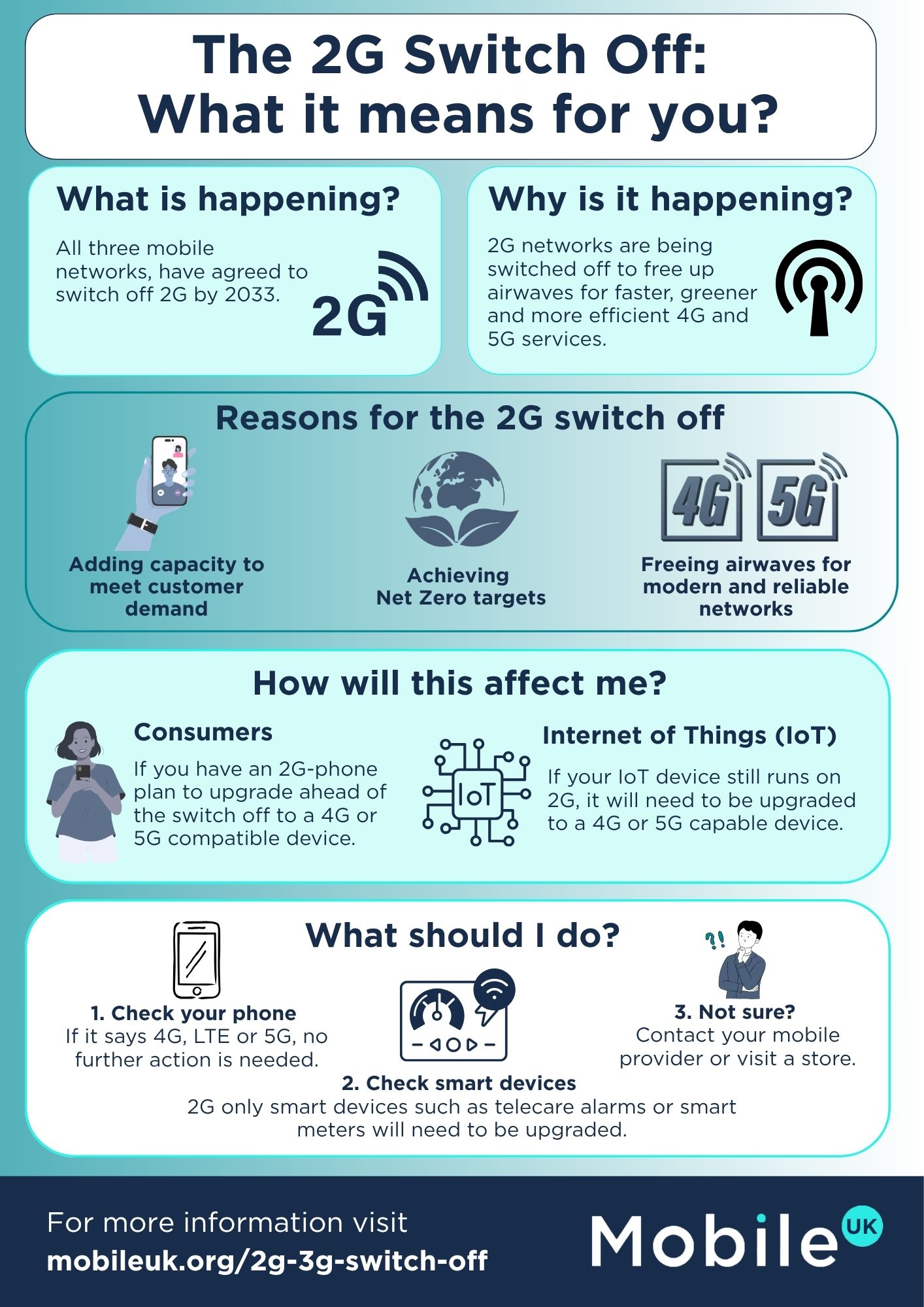
Click the infographic to download in full
The United Kingdom is currently undergoing a phased decommissioning of its 2G and 3G mobile network infrastructure. This transition is driven by several key factors:
- Spectrum Re-allocation:
The radio frequency spectrum utilised by 2G and 3G networks is being re-allocated to facilitate the expansion and enhancement of 4G and 5G services. - Infrastructure Modernisation:
The maintenance of legacy 2G and 3G infrastructure presents increasing logistical and financial challenges. Newer network technologies offer improved performance and energy efficiency. - Technological Advancement:
The growing demand for high-bandwidth mobile data and advanced communication services necessitates the deployment of 4G and 5G networks, rendering older technologies increasingly obsolete. - Energy Efficiency:
Newer network technologies are more energy efficient, and this is a major driving factor in the switch over.
The decommissioning of 2G and 3G networks is a strategic move to optimise the UK's mobile network infrastructure, ensuring its capacity to support future technological advancements and evolving user demands.
Key Considerations:
- Ofcom is overseeing the switch-off to ensure minimal disruption.
- Mobile network operators are expected to provide support for vulnerable customers.
- It is very important to contact your mobile phone provider for the most up to date information regarding their switch off plans.
- The 3G network switch off is well under way, so if you have a 3G only device, that will also soon be obsolete.


