
News
September 17, 2026
Lost Sites, Lost Signal: Why Maintaining Connectivity Through Redevelopment Matters for the UK

We have all stood on a crowded concourse watching a ticket refuse to load or tried navigating a busy street as the map spins endlessly. While the natural assumption is to blame the networks, the root cause is often far more complex: critical mobile infrastructure is having to be removed during urban redevelopment, leaving operators racing to preserve coverage for local communities.
Mobile UK actively champions redevelopment; it creates essential housing, modern workspaces, and renewed public areas. However, as buildings are updated or repurposed, rooftop mobile equipment must inevitably move. Notices to Quit (NTQs) are an understandable part of the property lifecycle, but through unforeseen circumstances, the unintended consequence is the severe degradation or outright loss of mobile signal when infrastructure is taken down.
Mobile UK has long highlighted that NTQs are already a serious concern across the sector, and one that is only growing. Now, a report by VodafoneThree, Lost Sites, Lost Signal: The Impact of Notices to Quit on Londoners, reinforces what we have consistently argued.
When schemes proceed, operators typically receive an 18-month legal notice to vacate. Yet securing planning approval and building a permanent replacement site in dense urban areas routinely takes five years—and sometimes up to eight. When infrastructure is removed without an immediate replacement, the surrounding community effectively loses its connectivity, leaving residents and businesses stranded with weakened or unusable coverage.
The report sets out the human and economic cost:
- Pervasive Coverage Gaps: Nearly half a million Londoners could be living in areas where mobile signal has been degraded by lost infrastructure.
- Critical Hubs Compromised: Site removals affect roughly 20% of London high streets and 3 of the capital's 5 busiest rail stations.
- Severe Economic Drag: London loses an estimated £2.7bn in economic output annually due to NTQ disruptions.
- Deepening Inequalities: Two-thirds (66%) of social renters rely on mobile data daily at home when fixed broadband fails, meaning lost signal directly impacts digital inclusion.
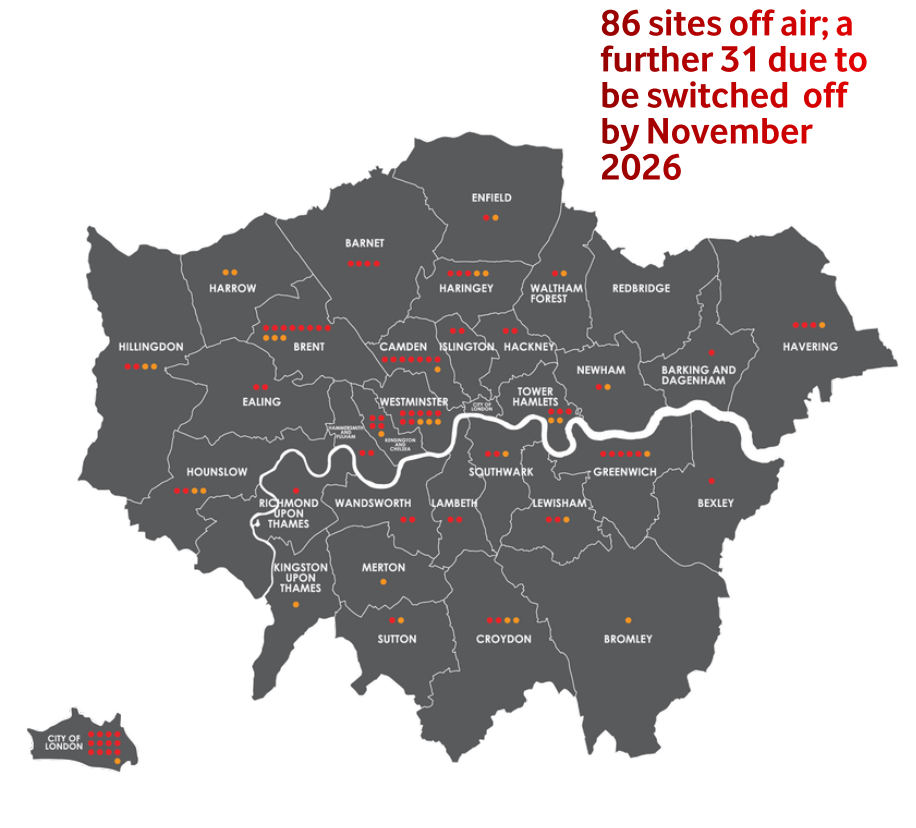
Map illustrating the spread of 86 disconnected sites and 31 impending switch-offs across London.
Crucially, this is not about pitching development against digital infrastructure. Both are vital, and it is in everyone’s shared interest to maintain continuous mobile service. This reinforces Mobile UK’s Mobilise Britain campaign: modern planning must ensure building for tomorrow does not inadvertently switch off connectivity today.
While acutely visible in London today due to dense redevelopment, this is not just a London issue. As redevelopment accelerates across Birmingham, Manchester, Leeds, and Glasgow, similar signal losses will hit communities nationwide without national policy intervention.
To protect continuous coverage, Mobile UK and the report call for pragmatic action:
- Early Planning Consultation: Require developers to consult operators during pre-application so replacement sites can be planned before infrastructure is removed.
- Extend Temporary Site Rights: Lengthen permitted development rights for temporary masts from 18 to 36 months to keep communities connected while permanent masts are secured.
- Local Authority Collaboration: Encourage councils to actively support replacement sites by opening up suitable public assets.
Read the full report: VodafoneThree NTQ Report.
About Building Mobile Britain

Building Mobile Britain is a campaign created by Mobile UK seeking to work with national and local government, as well as interested industry groups to overcome the challenges we face with expanding the existing mobile networks, while also developing innovative services for customers.
See here for further information - or #BuildingMobileBritain
Media Contacts
Gareth Elliott
Head of Policy and Communications
Tel: 07887 911 076
Email: press@mobileuk.org


