
News
November 20, 2026
Britain's £100bn Mobile Opportunity: Why Regulations Risk Throttling It

From high-tech factories and supercharged railways to cheaper bills for hard-pressed families, modern 5G can transform Britain. But 20-year-old red tape is locking up the prize.
Every day, millions of people across the UK glance at their smartphones on the high street, tap to pay, navigate roads, or connect with colleagues—taking seamless wireless connectivity for granted. Mobile networks have become the invisible utility underpinning modern British life and the silent engine of our digital economy, relied upon so implicitly that the complex engineering making it possible is largely invisible.
Yet behind our screens, the regulatory framework governing our mobile networks remains stubbornly anchored in the past. Conceived in the era of desktop computers and dial-up broadband, the UK's legacy 'net neutrality' rules treat all data packets identically. While this approach once protected early web browsing, it now inadvertently locks mobile operators into functioning as 'simple pipes'—selling undifferentiated buckets of gigabytes at low prices while data demand quadruples, stifling the investment needed to build the nation’s next-generation digital backbone.
The £100 Billion Economic Prize
The next generation of mobile tech—5G Standalone—is not just about downloading a film a bit faster. It is an intelligent, software-powered network capable of offering greater flexibility to prioritise critical traffic at key moments
According to independent parliamentary evidence, unleashing this technology nationwide will hand the UK economy an eye-watering £100 billion (£102.75 billion) boost in economic growth over the next decade.
Even better, it creates 13,000 top-tier regional engineering and tech jobs—with almost two-thirds of the economic benefits flowing straight to the North, the Midlands, Scotland, Wales, and Northern Ireland.
Saving Billions for Our Strained Public Services
The prize is not just about big business; it directly saves our frontline public services money:
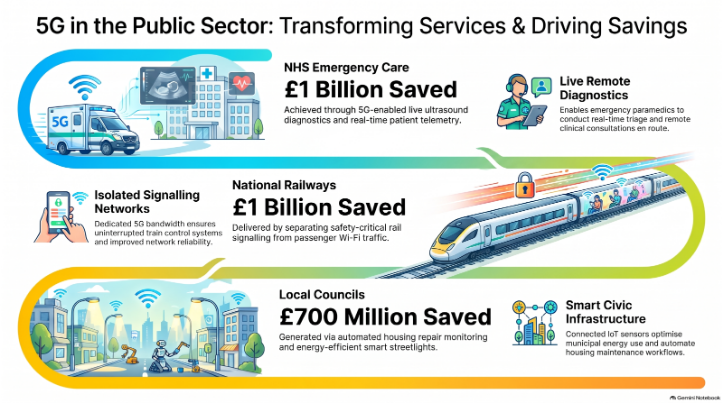
Why Old Rules Threaten to Blow the Opportunity
So, what is holding this back? Under our current, outdated rulebook, mobile operators face legal uncertainty and a 'permission-to-try' barrier whenever they try to offer dedicated, high-performance channels. Regulators treat dynamic traffic management with suspicion, leaving network builders fearful of falling foul of red tape.
A Win-Win for Both Ends of the Market
Critics often claim that modernising these rules will hurt ordinary consumers. The truth is the exact opposite. Reform delivers a balanced win for everyone:
- At the Premium End: Big logistics firms, ports, broadcasters, and factories are crying out for dedicated, ultra-reliable connectivity—and they are ready and willing to pay for it. Allowing operators to sell these specialized services injects vital private investment straight into our national digital network.
- At the Everyday & Non-Premium End: Not everyone needs a supercharged industrial slice or lightning-fast gaming performance. An updated, flexible framework ensures hard-pressed households and vulnerable families aren't forced into paying for expensive, bloated contracts packed with bells and whistles they will never touch. It gives providers the freedom to offer simple, dirt-cheap basic packages.
- Protecting the Essentials: Crucially, the profits made from commercial corporate deals help cross-subsidise the network for everyone else—funding new masts in rural signal blackspots and keeping vital lifelines, like online NHS advice and emergency helplines, completely free to access.
Common Sense for Britain's Future
Nobody wants an unregulated free-for-all. The core principles of the open internet—stopping companies from blocking websites or picking corporate winners—must stay firmly in place.
Images: AI Generated
About Building Mobile Britain

Building Mobile Britain is a campaign created by Mobile UK seeking to work with national and local government, as well as interested industry groups to overcome the challenges we face with expanding the existing mobile networks, while also developing innovative services for customers.
See here for further information - or #BuildingMobileBritain
Media Contacts
Gareth Elliott
Head of Policy and Communications
Tel: 07887 911 076
Email: press@mobileuk.org


